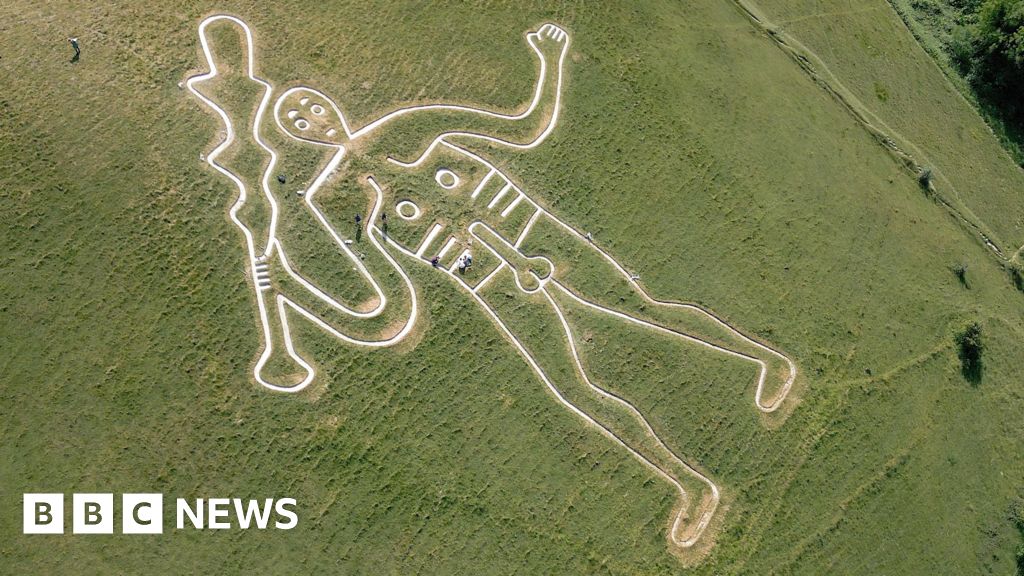
The Cerne Abbas Giant, the naked club-wielding figure carved into a Dorset hillside, is getting a rare emergency makeover this week after relentless rain threatened to erase his silhouette. National Trust rangers and 300 volunteers are hauling 17 tonnes of fresh chalk up the steep slope to restore the outline before algae and wet weather dull the landmark’s once-crisp edges.
Luke Dawson, a National Trust ranger overseeing the project, says heavier and more frequent winter rains are eroding the chalk faster than the team can replace it. “The outline is greener, fuzzier, and less distinct between maintenance cycles,” Dawson said. “It’s not just about keeping him visible—it’s about preserving a piece of living history.” The Giant has been rechalked roughly every decade since the National Trust took over in 1920, but the recent shift in weather patterns has forced an early intervention.
- Algae growth — Damp, mild conditions are accelerating moss and algae blooms that smudge the figure’s edges.
- Erosion risk — The combination of heavier rains and slower grass regrowth in summer exposes the chalk to wind and water damage.
- Climate impact — While the Trust stops short of blaming climate change directly, Dawson notes the trend aligns with Met Office forecasts of warmer, wetter winters and erratic summers.
The rechalking process is labor-intensive and unchanged for generations: volunteers dig out the old chalk, then pack fresh material into the figure’s grooves by hand. The work is taking place during a heatwave, adding to the physical strain. Chole Baugh, a first-time volunteer, laughed as she scraped chalk into the Giant’s shin under a blazing sun. “I never thought I’d be sweating over a 55-metre naked man,” she said. “But after today, I have a new appreciation for the people who’ve done this for centuries.”
Key Points
- ⚠️ The Giant is being rechalked 3 years early due to accelerating erosion from heavier winter rains
- ✅ 17 tonnes of chalk and 300 volunteers are required for the 15-day project
- 🌍 Wetter, milder winters are dulling the outline between maintenance cycles
This emergency refresh comes just months after the National Trust raised £330,000 to purchase 138 hectares of surrounding land. The newly protected area includes rare chalk grassland and habitat for endangered species like the Duke of Burgundy butterfly. The purchase aims to safeguard not just the Giant’s outline, but the entire landscape that has shaped his story.
| Aspect | Old Approach | New Reality |
|---|---|---|
| Chalking Frequency | Every 10 years | Every 7 years (and potentially more often) |
| Climate Impact | Minimal erosion between cycles | Noticeable dulling and algae growth |
| Volunteer Role | Occasional support | 300-person coordinated effort required |
The Giant’s origins remain shrouded in mystery, despite recent scientific analysis. Sediment studies in 2021 suggested he was likely carved between 700 and 1100AD, far later than once believed. Yet in 2024, Oxford University researchers argued he may represent Hercules, possibly serving as a rallying point for West Saxon armies. Local historian Ian Denness calls the debate “a real ding-dong,” noting how the figure has been alternately framed as a fertility symbol, a Roman invader’s taunt, or even a satire of Oliver Cromwell.
📋 By The Numbers
- 55 metres — The height of the chalk figure, making it visible for miles across the Dorset countryside
- 1920 — The year the National Trust took over stewardship of the site
- 341 acres — The newly purchased land added to the Giant’s protected landscape
As the volunteers work, the Giant’s outline slowly re-emerges from the green haze. Dawson watches as the chalked lines sharpen under the sun. “He’s not just a tourist attraction,” Dawson says. “He’s a living archive of how people have interacted with this land for over a thousand years. And right now, we’re racing to keep that archive legible.”
💡 Pro Tip
If visiting during rechalking, arrive early in the morning to avoid the heat and see the Giant’s outline emerge in stages—it’s a rare chance to witness history being preserved in real time.