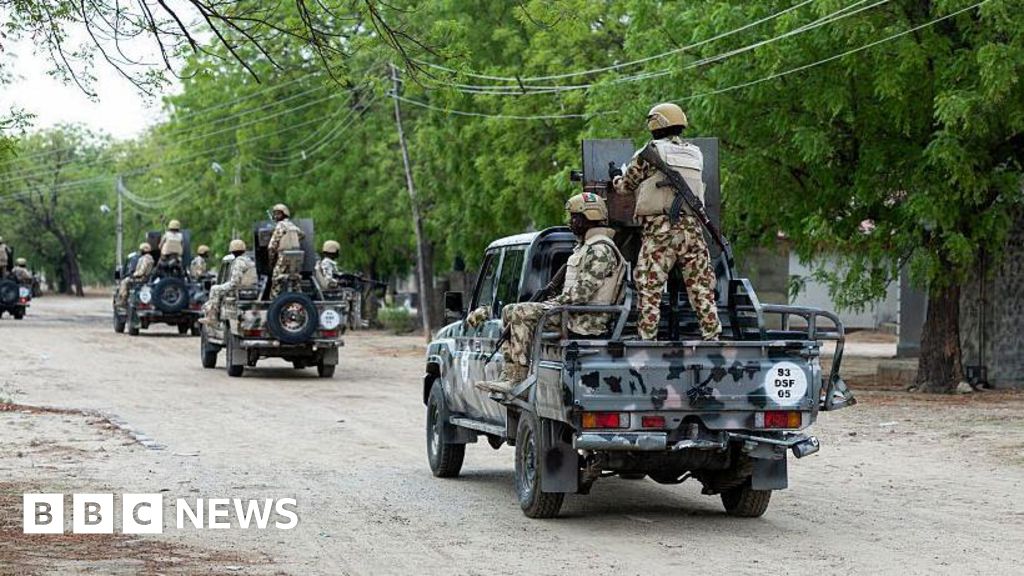
American and Nigerian special forces have killed the second-in-command of Islamic State’s global leadership in a coordinated raid in Nigeria’s Borno State, President Donald Trump confirmed Wednesday. The operation, conducted on Tuesday night near the town of Bama, targeted a high-value compound where intelligence indicated the ISIS commander was stationed. Nigerian military officials reported the site was under 24-hour surveillance before the strike, which involved both air and ground assaults.
Trump, speaking to reporters at the White House, described the militant as the “second-highest ranking” ISIS figure in Africa and a key strategist for the group’s expansion across the Sahel. The president did not disclose the commander’s name but said the target was identified through “advanced intelligence sharing” between U.S. and Nigerian agencies. Nigerian Defense Minister Bashir Salihi Magashi later confirmed the operation’s success in a televised address, stating that “no civilian casualties were reported.”
📋 By The Numbers
- 2nd-ranking ISIS leader in Africa — Confirmed by U.S. and Nigerian officials
- Tuesday night strike — Coordinated assault involving air and ground forces
- Zero civilian casualties — Claimed by Nigerian military
The ISIS leader, believed to be a Nigerian national with ties to the group’s West Africa Province, had been instrumental in orchestrating attacks against Nigerian security forces and civilian targets. Military analysts note that his elimination disrupts ISIS’s ability to plan large-scale operations, though the group has not yet issued a formal response. Borno State has been a hotspot for insurgent activity, with ISIS-affiliated fighters frequently clashing with Nigerian troops and allied militias.
| Group | West Africa Province | Central Africa Province |
|---|---|---|
| Leadership | Decentralized, local commanders | Centralized, foreign influence |
| Operational focus | Nigeria, Niger, Chad | DRC, Mozambique |
Nigerian military spokesman Maj. Gen. Edward Buba stated that the operation was months in planning, involving intelligence from multiple African and Western agencies. “This was not a spontaneous strike,” Buba told reporters. “The target’s movements were tracked for weeks, and the timing was chosen to minimize collateral damage.” The raid follows a string of recent successes by Nigerian forces against ISIS-affiliated groups, including the capture of a major arms depot in December.
💡 Pro Tip
Military analysts warn that ISIS’s regional affiliates often regroup quickly after leadership losses. Tracking mid-level operatives—rather than just high-value targets—can reveal the group’s next operational hubs.
While the operation is a tactical victory, security experts caution that ISIS’s Africa Province remains a resilient threat. The group has repeatedly demonstrated its ability to adapt, even after leadership decapitations, by leveraging local grievances and weak governance in the Sahel. The U.S. has pledged continued support to Nigerian forces, including intelligence sharing and counterterrorism training, as part of its broader counter-ISIS strategy in the region.
Key Points
- ✅ U.S. and Nigerian forces killed ISIS’s second-ranking leader in Africa
- ⚡ Operation conducted in Borno State, Nigeria, with zero civilian casualties reported
- 💡 The commander was a key strategist for ISIS’s Sahel expansion
The Pentagon confirmed that American forces provided logistical and intelligence support but did not participate directly in the ground assault. This marks the latest in a series of high-profile counterterrorism operations targeting ISIS affiliates across the continent, including recent strikes in Libya and Somalia. Nigerian President Bola Tinubu praised the operation as a “major milestone” in the fight against insurgency, though he acknowledged that “the war is far from over.”
- Intelligence gathering — Months-long surveillance of the target’s movements
- Precision strike — Coordinated air and ground assault to minimize civilian harm
- Post-operation assessment — Nigerian military reviewing captured materials for further leads
As of Wednesday evening, ISIS has not named a successor, leaving analysts to speculate whether the group will promote a local commander or seek to import a replacement from its Middle Eastern core. The absence of a clear leadership transition could create internal fractures, potentially weakening the group’s operational cohesion in the region.