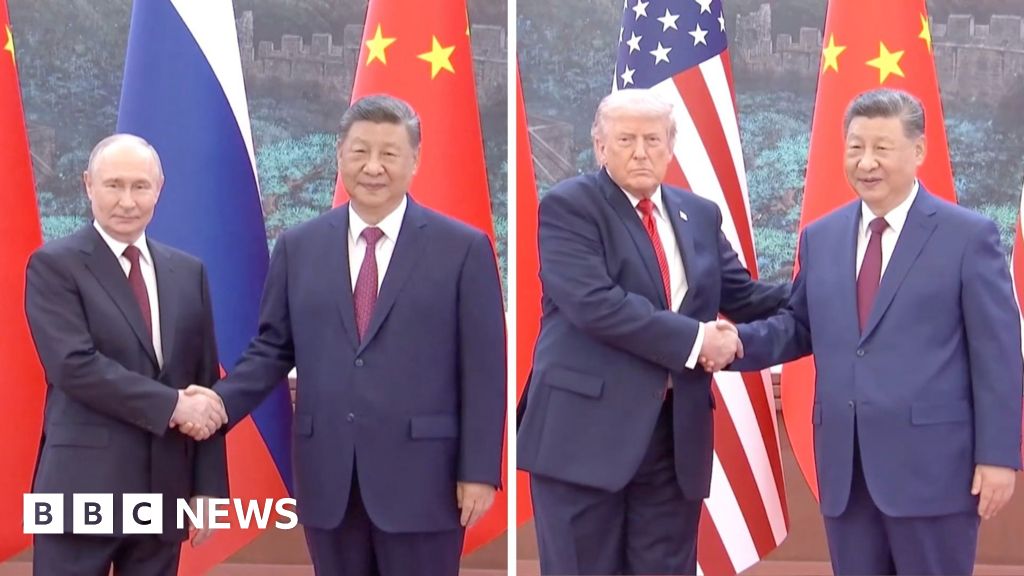
China’s President Xi Jinping staged a near-carbon-copy welcome for Donald Trump last week and Vladimir Putin on Tuesday, complete with synchronized marching bands, fluttering national flags and rows of waving schoolchildren. The identical choreography in Tiananmen Square delivered a message Beijing insists is non-political: protocol trumps politics.
Xi greeted Trump on April 26 with a 21-gun salute and a 45-minute bilateral meeting; Putin received the same treatment on April 28, including a 30-minute one-on-one with Xi and a joint press conference where both leaders emphasized “strategic cooperation.” The parallel ceremonies unfolded despite Beijing’s formal stance that Russia and the United States are treated as “comprehensive strategic partners” and “cooperative partners” respectively.
📋 Protocol Clock
- 21-gun salute — Fired for Trump on April 26 at 10:15 a.m.
- 21-gun salute — Fired for Putin on April 28 at 9:45 a.m.
- 45 minutes — Length of Trump-Xi meeting
- 30 minutes — Length of Putin-Xi meeting
Sources inside China’s Ministry of Foreign Affairs said the identical arrangements were intentional, designed to avoid any perception of favoritism while maintaining the veneer of impartial hospitality. “The optics matter more than the substance,” said one diplomat who requested anonymity. “Beijing wants both sides to believe they are being treated equally, even when their interests diverge.”
Key Points
- ✅ Both leaders received 21-gun salutes and identical welcome ceremonies
- ⚡ Ceremonies were held within 48 hours of each other
- 💡 China claims neutrality despite deeper ties with Russia
A Western diplomat stationed in Beijing told this reporter that the timing was “no accident.” The U.S. delegation arrived on April 24 and departed April 27; the Russian delegation landed April 26 and left April 28. “It reads like a carefully timed diplomatic minuet,” the envoy said. “Each side gets the full treatment, but neither gets the substance.”
💡 Pro Tip
Diplomatic observers should watch for subtle shifts in language during joint statements—subtle cues often reveal Beijing’s true leanings before official policy changes.
The carefully calibrated displays came as U.S.-China trade talks stalled in Geneva and Russia finalized a 30-year gas supply deal worth $117 billion. Analysts say Beijing is walking a tightrope: courting Western investment while deepening energy ties with Moscow to hedge against sanctions and supply chain disruptions. “China doesn’t want to be seen choosing sides,” said Li Mingjiang, associate professor of international relations at Singapore’s Nanyang Technological University. “But the red carpet speaks louder than the fine print.”
| Aspect | United States | Russia |
|---|---|---|
| Bilateral meeting length | 45 minutes | 30 minutes |
| Joint press conference | Yes | Yes |
| Trade talks status | Stalled in Geneva | Advancing gas deal |
| Sanctions exposure | Low | High |
Security footage from the Great Hall of the People shows Xi personally escorting Trump to the elevator bank and Putin to the same bank moments later, underscoring the visual symmetry. The only discernible difference: Trump’s motorcade departed via the East Gate; Putin’s exited through the West Gate—mirroring the geopolitical divide Xi seeks to obscure in public.
- 📊 The identical ceremony scripts suggest Beijing prioritizes optics over geopolitical alignment
- 🔍 Trade talks with the U.S. remain deadlocked while energy deals with Russia advance
- ⚠️ Subtle protocol differences—like gate selection—may hint at China’s subtle preferences
In private, Chinese officials have described the visits as “ritual diplomacy,” a way to signal stability amid global uncertainty. But the choreographed harmony belies underlying tensions: Washington accuses Beijing of aiding Moscow’s war economy, while Moscow warns Beijing against leaning too far toward the West. “The red carpet can’t hide the thorns underneath,” said a senior Asian diplomat who declined to be named.
- First — Identical ceremonies preserve Beijing’s narrative of neutrality
- Second — Trade deadlocks and energy deals expose deeper strategic divergences
- Third — Subtle protocol cues reveal China’s unspoken leanings
The double pageantry concludes a week in which Beijing reasserted its role as a global stage manager. Whether the choreography translates into tangible policy remains unseen. For now, the cameras roll, the flags wave, and the world watches the performance.