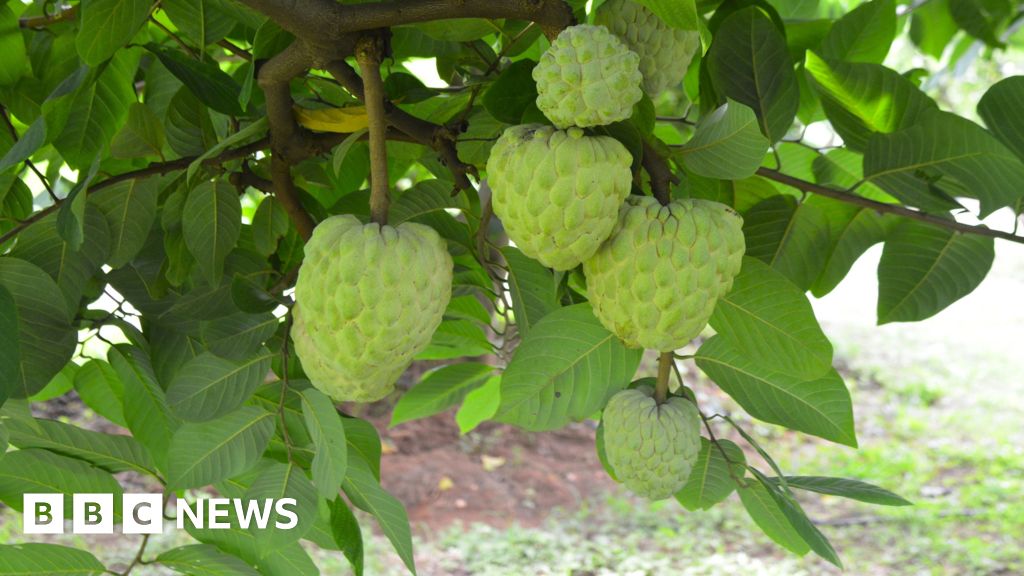
The dusty fields of Kolar district in southern India, once synonymous with failed monsoons and barren soil, are now flush with a new green gold: custard apples. Few believed the fruit—known locally as *sitaphal*—could thrive where traditional crops withered, but Ashoka Shivareddy proved them wrong. After spending years driving taxis in Bangalore to support his family, the 42-year-old farmer returned home in 2018 and planted his first 50 trees. Today, his orchard stretches over 12 acres and produces 8 metric tons of custard apples annually, each fetching £225 in local markets.
Shivareddy’s success has triggered a quiet agricultural revolution. The Karnataka state government allocated £4.2 million in 2024 to subsidize custard apple saplings and irrigation systems, aiming to convert 2,500 acres to the crop by 2026. His story has become a case study in the Indian Council of Agricultural Research’s drought-resilience programs, which now recommend sitaphal as a low-water alternative to sugarcane and paddy.
| Crop Comparison | Custard Apple (sitaphal) | Traditional Rice (paddy) |
|---|---|---|
| Water Requirement (per acre) | 2.5 million liters | 15 million liters |
| Income (annual per acre) | £1,800–£2,250 | £1,125–£1,500 |
| Drought Tolerance | High | Low |
At the Kolar Agricultural Market, traders report a 300% surge in custard apple transactions since 2020. Exports to the Middle East have also climbed, with Dubai-based importers signing contracts for 1,200 metric tons this year—up from just 150 in 2019. Farmers like Shivareddy now earn enough to send their children to private schools, a rarity in the district’s farming communities. His wife, Lakshmi, who once worked as a daily wage laborer, now manages the family’s post-harvest processing unit, where the fruit is sorted, waxed, and packed for transport.
Key Takeaways
- ✅ Custard apples use 80% less water than paddy rice
- ⚡ 400 farmers in Kolar have switched to sitaphal since 2020
- 💡 Exports to the UAE jumped 700% in five years
Yet the shift hasn’t been seamless. The fruit’s two-month window for market readiness forces farmers to time their harvests precisely, and unseasonal rains can split the skin, ruining entire batches. To mitigate risks, Shivareddy and others have adopted micro-irrigation systems, reducing water use by 40%. The Karnataka government has also rolled out weather-linked crop insurance, covering losses up to £750 per acre. “We’re no longer praying for rain,” Shivareddy said. “We’re praying for cooler nights during flowering season.”
💡 Pro Tip
Farmers should plant custard apple trees between June and August to align with the southwest monsoon’s onset, ensuring roots establish before the dry season.
The boom has attracted scrutiny from environmentalists, who warn that unchecked expansion could deplete groundwater in pockets of Kolar. Hydrologists from the Indian Institute of Science estimate that 15% of borewells in the district now show signs of over-extraction, despite custard apples requiring less water than other crops. Critics argue that the state’s subsidies—while well-intentioned—fail to account for long-term soil health. “Custard apples are a band-aid solution,” said Dr. Ananya Reddy, an agroecologist at the University of Agricultural Sciences. “They’re better than nothing, but the real answer lies in diversifying into millets and pulses.”
📋 By The Numbers
- 1,800 — Hectares converted to custard apple farming in Kolar since 2020
- 70% — Increase in local employment from post-harvest processing jobs
- 6 months — Average time from planting to first harvest for sitaphal trees
For Shivareddy, the debate is secondary. His orchard’s success has already transformed his village, Nandagudi, where new brick homes now replace thatched roofs. His neighbor, Ravi Kumar, uprooted his 10-acre sugarcane field last year and planted 2,000 custard apple trees. “I made £3,000 last season,” Kumar said. “With rice, I’d be lucky to clear £750.” The once-skeptical villagers now gather under the shade of Shivareddy’s trees in the evenings, plotting the next phase of their unlikely revolution.
- 2018 — Shivareddy plants first 50 custard apple trees
- 2020 — Karnataka introduces sitaphal subsidy program
- 2024 — Exports to Dubai exceed 1,200 metric tons annually
- 2026 — State targets 2,500 acres under custard apple cultivation