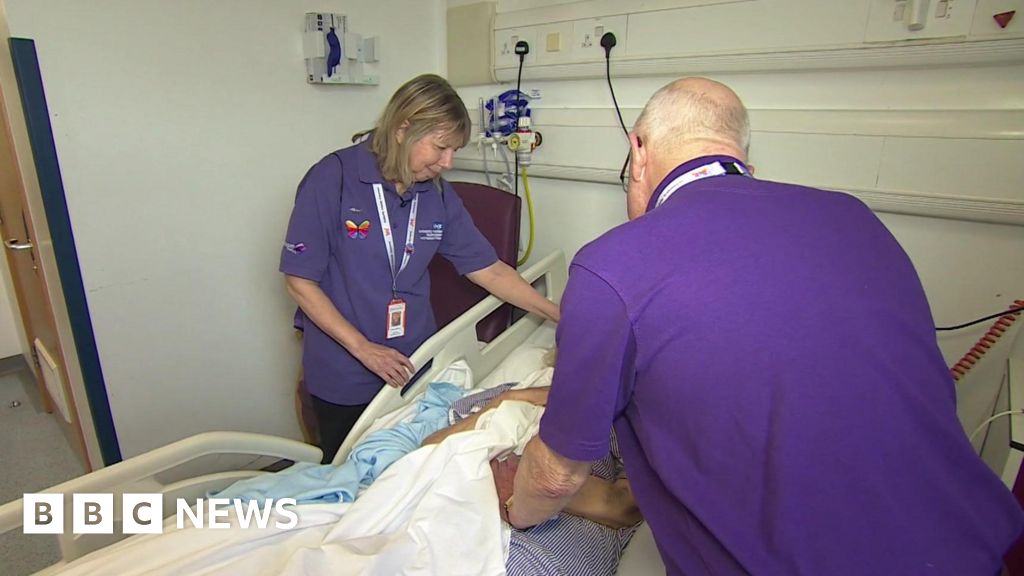
University Hospital Southampton has quietly launched the city’s most ambitious end-of-life care initiative in decades. Starting today, 120 trained volunteers will begin sitting with terminal patients who have no family present, ensuring no one dies alone. The program, named *Companions at the End*, begins with a cohort of 30 volunteers already active in Ward B, where Colin Harris, 78, became its first beneficiary last night.
Colin, a former dockworker diagnosed with advanced lung cancer, had no visitors for three weeks. His daughter lives in Australia and could not travel. Norman Bainbridge, a retired teacher volunteering with the program, spent two hours with Colin on Wednesday evening. "He wasn’t just talking about the weather," Bainbridge said. "He was telling me about his days on the quays. That’s a life worth remembering."
Key Points
- ✅ 120 volunteers trained and ready to deploy across University Hospital Southampton
- ⚡ Program begins with 30 volunteers in Ward B, scaling to full capacity by March 2025
- 💡 Each volunteer undergoes 40 hours of training in palliative care and emotional support
The hospital’s board approved the £4.2 million budget for 2026 in a unanimous vote last month. Of that, £2.1 million will fund volunteer stipends, £1.5 million covers training and coordination staff, and £600,000 is allocated for grief counseling services for families who later request support. "This isn’t just about company," said Dr. Priya Mehta, the hospital’s director of palliative care. "It’s about dignity. About proving that even in death, no one is invisible."
| Aspect | Current Practice | Companions at the End |
|---|---|---|
| Patient Monitoring | Staff check on terminal patients every 2–4 hours | Volunteer assigned continuously during absence of family |
| Emotional Support | Limited to nurse interactions; no specialized training | 40-hour certified program in grief, communication, and cultural sensitivity |
| Logistics | No system for tracking family availability | Digital dashboard flags patients with no visitors for 48+ hours |
Volunteers wear teal scrubs and carry laminated ID cards bearing the program’s slogan: *Until the last breath*. They are instructed to respect silence as much as conversation, to hold hands if asked, and to document each interaction in a secure app that feeds data to the palliative care team. So far, 18 patients have been matched with volunteers since the soft launch in October. Seven have passed away peacefully with a companion present.
📋 By The Numbers
- 7 — Patients who died with a volunteer present during soft launch
- 40 — Hours of mandatory training per volunteer
- 3 — Weeks from approval to first deployment
Janice Okoro, 62, a retired nurse volunteering in the program, recalls her first shift. "Mr. Patel kept apologizing for taking up my time," she said. "I told him, ‘You’re not taking anything. You’re giving.’" Mr. Patel died two days later, with Janice holding his hand. His son arrived 12 hours after his death.
💡 Pro Tip
Hospitals launching similar programs should prioritize matching volunteers to patients based on shared interests or backgrounds—music lovers with musicians, gardeners with those who loved the outdoors. Small overlaps can unlock meaningful conversations in final days.
Critics argue the program could burden already stretched staff, but hospital leadership insists volunteers are trained to escalate needs immediately. "Our nurses are not replaced," Mehta said. "They’re supported. The volunteers are the safety net." The program will expand to two more wards next month and is expected to serve over 300 patients annually by 2026. For Colin Harris, the initiative brought closure he never expected. His final words to Bainbridge were simple: "Thank you for seeing me."
- October 2024 — Pilot program launches with 10 volunteers
- January 2025 — Full ward deployment begins; 30 volunteers active
- March 2025 — All 120 volunteers trained and assigned
- 2026 — Program receives £4.2M annual funding
The initiative has drawn interest from 11 other NHS trusts, with Southampton acting as the flagship site. Bainbridge, now a program ambassador, visits new volunteers weekly. "Kindness isn’t a luxury," he said. "It’s a necessity. And now, it’s policy."