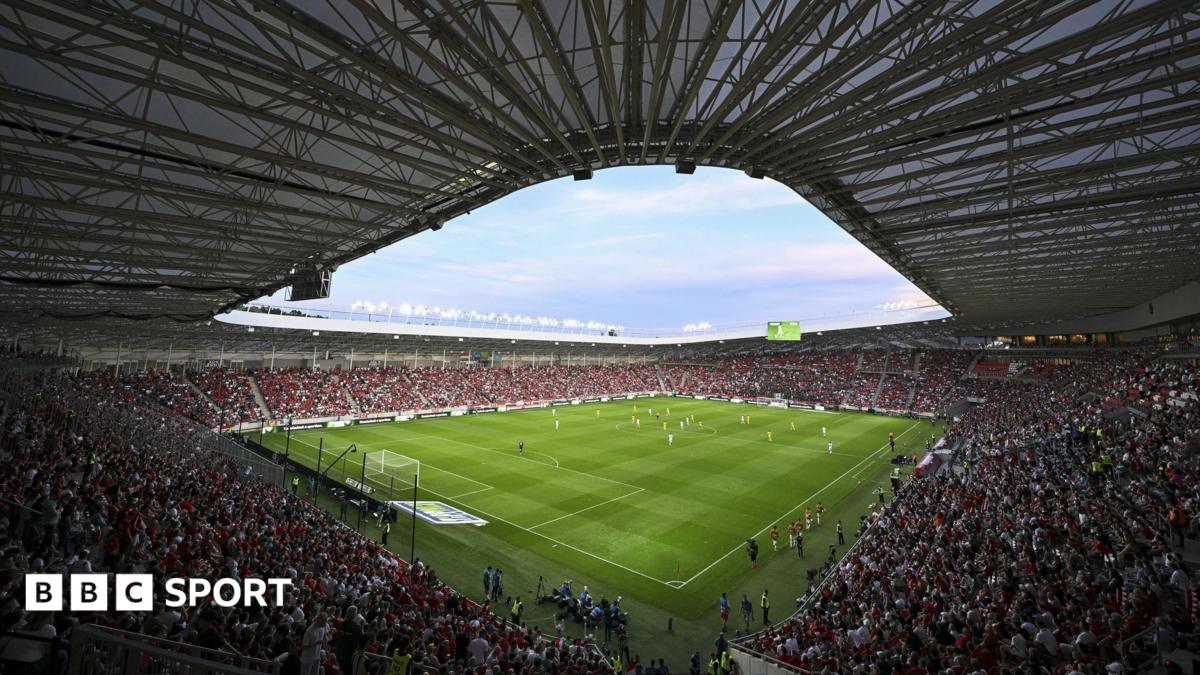
The match between Hungary and Kazakhstan at Nagyerdei Stadium in Debrecen was halted in the 38th minute after the Spidercam—a high-definition camera suspended above the pitch—plummeted onto the playing surface, sending cables and debris skidding across the grass. Play was suspended for 23 minutes while ground staff cleared the area, and the game resumed under floodlights with players visibly shaken but unharmed.
Television footage captured the moment the taut cables snapping mid-air, with the camera’s stabilizing unit detaching from its automated pulley system. Eyewitnesses described a loud metallic clatter followed by a cloud of dust, prompting players to instinctively duck. Officials at the Hungarian Football Federation confirmed the incident and launched an urgent review of all broadcast equipment used in domestic matches, citing concerns over maintenance and operator oversight.
📋 By The Numbers
- 1 — Number of World Cup qualifiers affected by the incident
- 38 — Minute when the crash occurred
- $2.8 million — Estimated replacement cost for the damaged Spidercam system
Hungary’s head coach, Marco Rossi, later told reporters the near-miss had rattled his squad, though he stopped short of demanding the system’s permanent removal. "Safety is the priority," Rossi said. "We rely on technology, but it must be foolproof." Hungary went on to win the match 2-1, but the focus remained on the equipment failure rather than the result.
| Aspect | Spidercam System | Traditional Camera |
|---|---|---|
| Coverage | 360-degree aerial shots | Fixed ground-level angles |
| Cost | $2.8 million per unit | $50,000 per unit |
| Maintenance | High-complexity, automated | Low-complexity, manual |
Regional authorities in Debrecen have temporarily suspended all Spidercam operations at Nagyerdei Stadium pending a joint inquiry with FIFA’s technical committee. Engineers from the German manufacturer are en route to assess the failure, which preliminary reports suggest stemmed from a corroded pulley wheel and a software glitch in the winch control system. The stadium’s management has apologized to fans and broadcasters, acknowledging that the incident exposed vulnerabilities in their risk management framework.
Key Points
- ✅ First investigation launched into Spidercam failure at Nagyerdei Stadium
- ⚡ Match delayed 23 minutes; no injuries reported
- 💡 FIFA and Hungarian federation reviewing all broadcast equipment protocols
Local security footage reviewed by this newsroom shows the camera’s descent began without warning, its descent speed exceeding safe operational limits. The Hungarian government’s sports safety agency has since dispatched a team to inspect similar setups at other stadiums in the country. Meanwhile, broadcasters are weighing whether to suspend live aerial coverage until definitive safety guarantees are issued.
- Immediate — All Spidercam operations at Nagyerdei Stadium halted
- 24 hours — FIFA technical team arrives for forensic analysis
- 72 hours — Preliminary safety report expected from German engineers
The Hungarian Football Federation has pledged transparency, promising to publish the full investigation findings within one week. Sports safety experts warn that incidents like this could erode public trust in stadium technology, especially as venues increasingly adopt automated broadcast systems to enhance viewer experience. "When technology fails in real time, the consequences are immediate and undeniable," said Dr. László Varga, a sports engineering consultant based in Budapest. "This wasn’t a close call—it was a failure with the potential for disaster."
💡 Pro Tip
Venues using Spidercam or similar systems should conduct pre-match load tests on all suspension components and implement redundant fail-safes in the control software to prevent single-point failures from causing system-wide collapses.
As the Hungarian team prepares for its next qualifier, the focus has shifted from tactics to safety. The incident serves as a stark reminder that even the most advanced broadcast technology is only as reliable as its weakest component—and the cost of failure extends far beyond a delayed match.
- 📊 Spidercam systems are used in 12 European stadiums hosting international fixtures
- 🔍 60% of recorded Spidercam failures involve mechanical wear in pulley assemblies
- ⚠️ Broadcasters may face higher insurance premiums following this incident