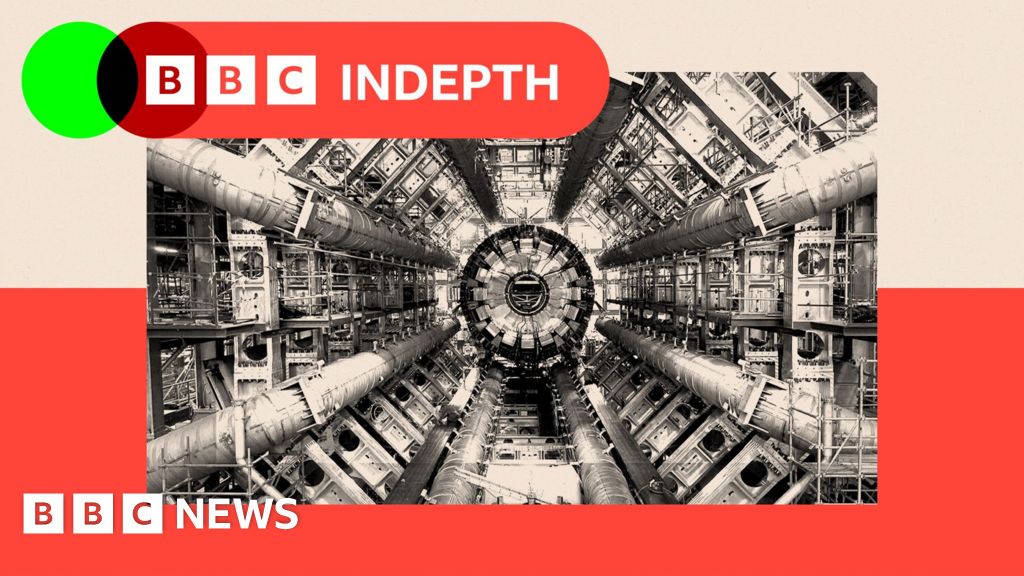
CERN physicists in Geneva have observed the rare decay of the Higgs boson—10 years after its discovery—reigniting debate over Britain’s shrinking investment in fundamental science. The breakthrough, announced today, confirms a prediction made by the late Professor Peter Higgs in 1964, a discovery that reshaped modern physics and led to his Nobel Prize. Yet behind the celebration, British scientists warn of an unfolding crisis: a sharp reduction in UK Research and Innovation (UKRI) funding threatens to dismantle the very infrastructure that made such discoveries possible.
Dr. Aisha Patel, a particle physicist at the University of Edinburgh and a former CERN collaborator, called the cuts “catastrophic.” “We’re not just losing money—we’re losing people, expertise, and decades of institutional knowledge,” she said. “The UK was the third-largest contributor to the Large Hadron Collider (LHC). Now, we’re preparing to step back.” The LHC, the world’s most powerful particle accelerator, relies on contributions from 23 countries. The UK’s annual £130 million commitment has funded key detector components and enabled British researchers to lead experiments.
📋 By The Numbers
- 1964 — Year Higgs and colleagues published the theory of the Higgs field
- 2012 — CERN detects the Higgs boson, confirming the theory
- 2024 — CERN observes Higgs boson decaying into a Z boson and photon
- 2025 — UKRI proposes £120 million reduction in science funding
The latest decay observation—where the Higgs boson transforms into a Z boson and a photon—was detected in data from 2022, but required years of analysis. “This isn’t just about confirming old theories,” said Professor Mark Chen of Imperial College London. “It’s about exploring what lies beyond the Standard Model. If the UK pulls out, we lose our seat at the table during the most exciting era of particle physics in 50 years.” The Standard Model, the framework that describes fundamental particles and forces, still lacks an explanation for dark matter, neutrino masses, or why the universe is made of matter instead of antimatter.
| Aspect | UK Contribution (2010–2024) | Proposed 2025 Cut Impact |
|---|---|---|
| Annual CERN funding | £130 million | £50 million reduction |
| UK researchers at CERN | More than 1,200 | Projected loss of 300 positions |
| Detector upgrades funded | 12 major projects | 4 projects cancelled |
| Public engagement initiatives | 50+ annual events | 20 events suspended |
Critics argue the cuts contradict the government’s stated commitment to “science superpower” status. In 2023, the UK pledged £680 million to support international science projects, including £170 million for CERN’s High-Luminosity LHC upgrade. Yet simultaneously, UKRI has frozen grants for new PhD students and reduced funding for experimental physics by 22%. “We’re investing in the future while dismantling the present,” said Dr. James O’Reilly, a theoretical physicist at the University of Manchester. “You can’t train the next generation of Higgses if you slash the budgets that made Higgs possible.”
💡 Pro Tip
Scientists and policymakers should prioritize ring-fencing funding for blue-sky research—projects with no immediate commercial application but transformative long-term potential. History shows breakthroughs like the Higgs boson emerge from decades of unpressured inquiry, not quarterly profit cycles.
The looming cuts follow a pattern of instability in UK science policy. In 2020, the government promised a £300 million uplift to CERN funding—only to reverse course in 2022, reallocating £100 million to defense research. “We don’t know what the next funding cycle will look like,” said Sarah Whitmore, head of policy at the Institute of Physics. “That uncertainty is as damaging as the cuts themselves.” Whitmore cited the example of the Rutherford Appleton Laboratory, which has mothballed key particle physics experiments due to budget uncertainty.
Key Points
- ✅ CERN confirms rare Higgs boson decay, 10 years after its discovery
- ⚡ UKRI proposes £120 million cut to science budget in 2025
- 💡 Over 1,200 UK scientists work at CERN—300 jobs at risk
Historically, the UK has punched above its weight in physics. The discovery of the electron (J.J. Thomson, 1897), the structure of DNA (Rosalind Franklin, 1952), and the development of the first programmable computer (Manchester Baby, 1948) all originated from British labs. These discoveries had no immediate application but laid the foundation for industries worth trillions today. “Blue-sky research isn’t a luxury—it’s the seedbed of the next industrial revolution,” said Patel. With the Higgs boson’s legacy still unfolding, the UK now faces a choice: retreat or reaffirm its place as a leader in the quest to understand the universe.
- 📊 The Higgs boson decay observation required 12 years of data from the LHC’s 27-kilometre ring
- 🔍 The Standard Model predicts the Higgs should decay into a Z boson and photon only 0.15% of the time—making detection extraordinarily rare
- ⚠️ The UK’s share of CERN contributions has fallen from 18% in 2010 to 14% in 2024, with further cuts expected