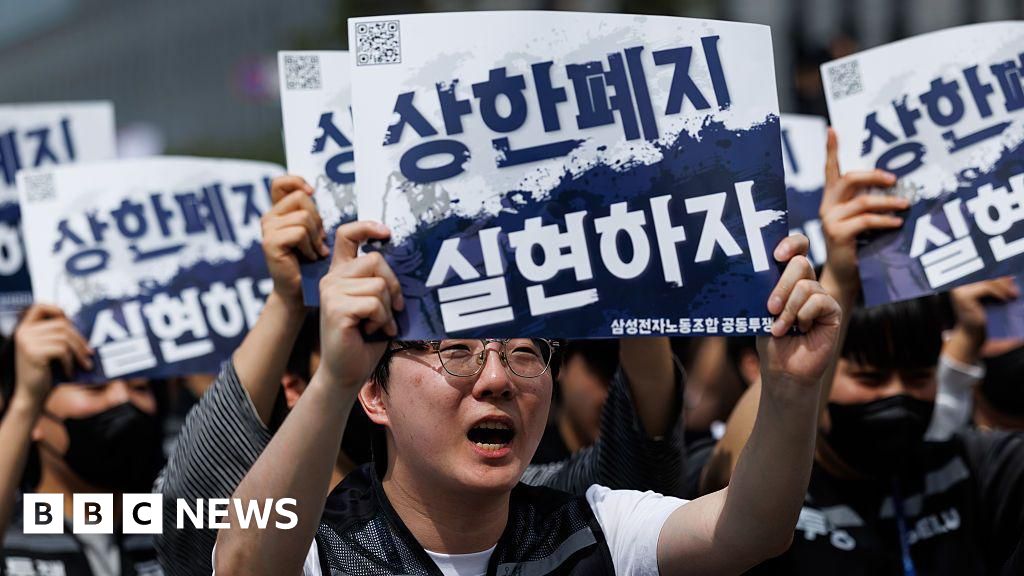
South Korea’s largest union at Samsung Electronics has called off a planned strike after securing a last-minute tentative pay agreement with the tech giant. The Korea Metal Workers’ Union (KMWU) announced the suspension late Friday, hours before workers were set to walk out at plants across Gyeonggi Province. The deal, still subject to ratification by union members, grants wage increases averaging 5.8% for 2024, with additional performance-linked bonuses proposed for 2025.
Key Points
- ✅ Strike suspended after tentative pay deal reached
- ⚡ Wage hikes average 5.8% for 2024, with performance bonuses eyed for 2025
- 💡 Agreement still requires ratification by union members
The breakthrough comes after weeks of tense negotiations that saw Samsung Electronics, the world’s largest memory chip maker, resist demands for steeper increases. The company had initially offered 3.5%, citing global economic uncertainty and falling semiconductor prices. Union leaders framed the compromise as a hard-won victory, though they acknowledged unresolved grievances over working conditions and subcontractor labor rights.
Workers at Samsung’s flagship semiconductor plants in Hwaseong and Pyeongtaek were poised to strike Monday, a move that analysts warned could have disrupted global supply chains for smartphones, servers, and AI hardware. The union’s decision to pause the action follows a marathon 18-hour bargaining session in Suwon, where negotiators reportedly conceded ground on profit-sharing terms to secure the tentative deal.
💡 Pro Tip
For industries reliant on semiconductor supply chains, even short strikes can trigger ripple effects—monitor union announcements in South Korea closely during contract renewal seasons.
Samsung Electronics, which employs over 110,000 workers in South Korea, faces broader pressures beyond wages. The company is navigating a cyclical downturn in chip prices, geopolitical tensions with China, and investor demands for higher margins. Analysts at Mirae Asset Securities note that while the wage deal is manageable, unresolved issues around automation and outsourcing could resurface in future negotiations.
| Negotiation Issue | Union’s Demand | Samsung’s Offer |
|---|---|---|
| Base Wage Increase (2024) | 8.5% | 3.5% (revised to 5.8%) |
| Performance Bonus (2025) | 15% of salary | 10% (tentative) |
| Subcontractor Labor Rights | Full regularization | Partial benefits, no hiring guarantees |
The tentative agreement now heads to a vote by 35,000 KMWU members across Samsung’s plants, with results expected by March 15. A rejection could reignite strike plans, potentially disrupting production lines critical to Apple’s iPhone supply and Nvidia’s GPU shipments. Samsung has contingency plans to reroute orders to overseas facilities in Austin, Texas, and Xi’an, China, but delays would still be inevitable.
📋 By The Numbers
- 35,000 — Number of Samsung workers represented by the KMWU
- 110,000 — Total employees of Samsung Electronics in South Korea
- 18 hours — Duration of the final bargaining session in Suwon
- March 15 — Deadline for union members to ratify the deal
Labor experts caution that the uneasy truce may only delay deeper conflicts. Hyundai Motor Group, another major South Korean employer, recently settled a similar dispute after a 24-hour strike, but tensions persist over automation’s impact on jobs. Samsung’s next contract negotiations are already scheduled for 2026, when the company plans to expand its use of AI-driven manufacturing—a move likely to face resistance from unions.
- March 1 — Tentative deal announced; strike suspended
- March 15 — Union ratification vote deadline
- Q3 2024 — Possible implementation of wage increases if ratified
- 2026 — Next round of contract negotiations anticipated
The standoff’s resolution offers temporary relief to global tech markets, but the underlying issues—wages, job security, and automation—are far from settled. Samsung’s leadership will need to balance shareholder expectations with labor demands, while workers weigh short-term gains against long-term stability in an industry undergoing rapid transformation.
