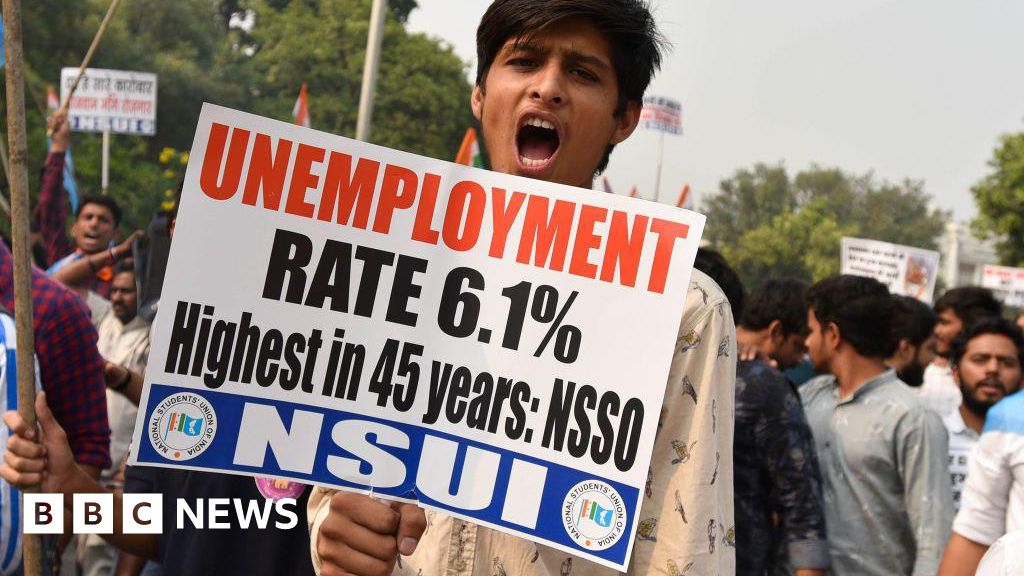
New Delhi — India’s young workforce is more educated than ever, yet over 23% remain unemployed, a crisis that has intensified in the past year. Government data released Friday shows youth joblessness hit 23.2% in July 2024, with graduates aged 20-29 facing the highest barriers to employment. The numbers contradict a decade of steady economic growth, exposing a deepening disconnect between higher education and labor market realities.
The study, conducted by the Labour Bureau of India, found that while 45% of unemployed youth hold at least a bachelor’s degree, only 12% of available jobs require such qualifications. This mismatch reveals a structural flaw in India’s education-to-employment pipeline, where universities churn out graduates for sectors that no longer exist at scale.
| Education Level | Unemployment Rate (July 2024) | Job Demand Growth (2023-24) |
|---|---|---|
| No Formal Education | 8.1% | +2.1% |
| Secondary School | 14.3% | +3.7% |
| Graduate Degree | 23.2% | +0.8% |
| Postgraduate Degree | 28.7% | -1.2% |
Engineering and business graduates, once prized by recruiters, now struggle to secure roles in a market saturated with similar qualifications. The IT sector, which absorbed thousands of engineering graduates annually, has slashed hiring by 40% since 2022 due to global slowdowns and automation. Meanwhile, vocational skills—such as plumbing, welding, and digital marketing—are in high demand but remain underrepresented in higher education curricula.
📋 By The Numbers
- 45% — Share of unemployed youth with a bachelor’s degree or higher
- 12% — Percentage of jobs requiring a graduate degree
- 40% — Drop in IT sector hiring since 2022
The government’s flagship skill development program, Skill India, has trained over 13 million people since 2015, yet only 30% have found employment within six months of completion. Critics argue the initiative lacks alignment with private sector needs, producing graduates in trades with little market demand. In Mumbai, a recent survey of 5,000 job seekers revealed that 68% had applied for roles requiring skills they did not possess, highlighting a systemic failure in career guidance.
Key Points
- ✅ Youth unemployment in India rose to 23.2% in July 2024, with graduates hit hardest
- ⚡ Only 12% of jobs require a graduate degree, despite 45% of unemployed youth holding one
- 💡 The IT sector has cut hiring by 40% since 2022, leaving engineers stranded
Economic analysts warn that without urgent reforms, the crisis could deepen. "India’s demographic dividend is at risk," said Dr. Arvind Panagariya, former vice-chairman of NITI Aayog. "The current trajectory suggests a lost generation of young Indians, educated but unemployable." The government has pledged ₹50,000 crore ($6 billion) toward employment-linked incentives in the 2025 budget, but economists question whether this will address the root causes of the mismatch.
💡 Pro Tip
Students should prioritize internships and certifications over degrees alone. Research shows that candidates with both theoretical knowledge and practical experience secure jobs 30% faster than those with academic credentials alone.
The crisis extends beyond urban centers. In rural Bihar, where agriculture employs 70% of the workforce, youth unemployment stands at 25%. Local leaders blame outdated education policies that fail to prepare students for agricultural innovation or rural entrepreneurship. "Our colleges teach outdated theories," said Ramesh Singh, a farmer in Patna district. "We need courses on agri-tech and sustainable farming, not just history and political science."
Key Points
- ✅ Rural youth unemployment in Bihar reaches 25%, tied to outdated education
- ⚡ Agriculture employs 70% of Bihar’s workforce, yet education ignores agri-tech
- 💡 Farmers demand courses in sustainable farming and rural entrepreneurship
Meanwhile, private sector solutions are emerging. Platforms like Apna and QuikrJobs are bypassing traditional hiring channels, offering gig-based employment to millions of underutilized graduates. These apps, which connect job seekers with short-term contracts, have seen a 200% surge in registrations since 2023. However, critics argue that gig work lacks stability and benefits, merely papering over the larger systemic issues.
- Immediate — Government must align education curricula with private sector demands
- Short-term — Expand vocational training programs in schools and colleges
- Long-term — Overhaul higher education to prioritize skill-based learning over rote memorization
