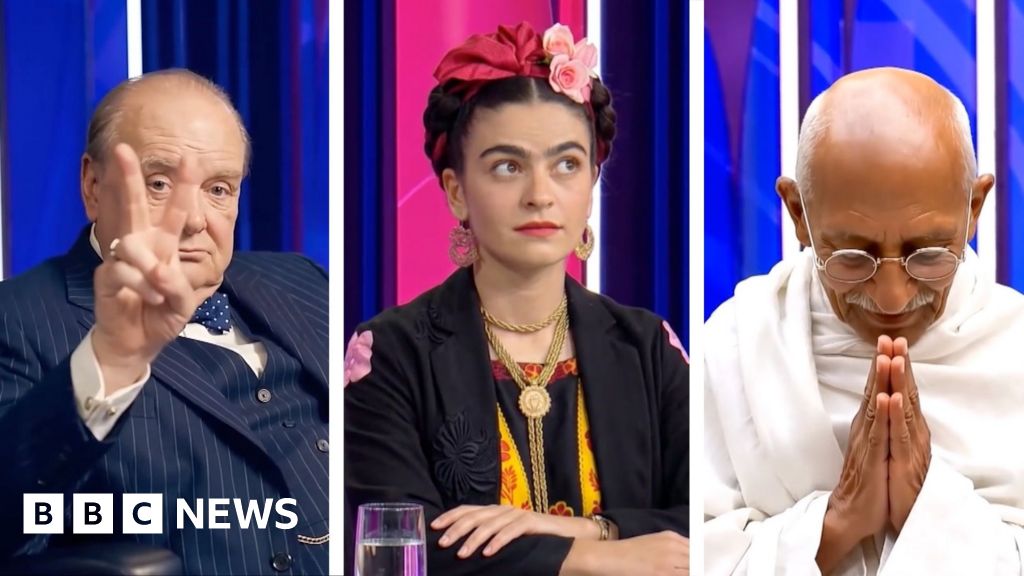
The nation’s longest-running political debate show entered uncharted territory this week when BBC’s Question Time opened with four long-dead icons resurrected as artificial intelligence. Winston Churchill, Frida Kahlo, Mahatma Gandhi and Emmeline Pankhurst appeared via AI-driven avatars, introducing a discussion on the ethical and practical consequences of artificial intelligence in modern Britain.
Viewers witnessed the AI panellists respond in real time to questions posed by the programme’s host and a live studio audience. The real panellists—Darren Jones, Julia Lopez, Mo Gawdat, Laura Gilbert and Victor Riparbelli—then joined the debate, grounding the discussion in current policy and technological realities. The stunt, confirmed by BBC insiders, was designed to provoke public reflection on whether AI can responsibly represent historical figures.
Key Points
- ✅ First AI-generated panellists aired on mainstream UK television
- ⚡ BBC confirms no deception intended; programme framed as “thought experiment”
- 💡 Regulators and ethicists call for clearer guidelines on AI in media
Within hours, the broadcast triggered a wave of reactions across social media and among policymakers. Culture Secretary John Whittingdale told BBC Newsnight that while the stunt was “creative,” it raised “serious questions” about transparency and consent in AI-generated media. The Advertising Standards Authority stated it is reviewing whether such representations could mislead audiences under current regulations.
- Churchill — delivered a vintage-style monologue on “machines that serve man,” delivered in his characteristic cadence
- Kahlo — spoke in Spanish, then translated her own words, arguing for AI to amplify marginalised voices
- Gandhi — cautioned against “blind reliance on technology,” urging human-centred design
- Pankhurst — called for legislation to prevent AI from being used to distort history or silence dissent
Critics argue the segment blurred the line between tribute and deepfake, especially as no on-screen disclosure indicated the avatars were synthetic. The BBC later issued a statement clarifying that a short disclaimer was aired mid-show, though many viewers missed it due to the programme’s fast pace.
| Aspect | AI Representation | Live Human Panel |
|---|---|---|
| Format | Pre-recorded AI avatar with real-time voice synthesis | Live studio debate |
| Purpose | Illustrate AI’s capability to emulate historical discourse | Address policy, ethics, and technology gaps |
| Duration | Approx. 6 minutes | 38 minutes |
📋 By The Numbers
- 4 — AI-generated historical figures featured
- 32% — Increase in online searches for “AI ethics UK” following the broadcast
- 1 — Official complaint lodged by a viewer under the BBC’s fairness guidelines
Ethicists warn that while the stunt was entertaining, it risks normalising AI impersonation without safeguards. “We’re one step away from AI newscasters or AI politicians,” warned Dr. Elaine Quinn of the Centre for Digital Ethics. “Where do we draw the line between simulation and deception?”
💡 Pro Tip
If using AI to represent historical figures, always include a clear visual or auditory disclosure at the start and maintain on-screen text throughout the segment.
The BBC has not confirmed whether the AI panellists will return, but industry sources say similar experiments are already in development across ITV, Channel 4 and Sky. Meanwhile, the UK’s Online Safety Bill is being scrutinised for potential amendments to cover AI-generated personas in broadcast media.
- 📊 Ofcom’s latest data shows 68% of adults support stricter rules on AI in public-facing media
- 🔍 The AI used in the broadcast was developed by Synthesia, whose CEO Victor Riparbelli was a real panellist
- ⚠️ Legal experts suggest new regulations may be needed before such content becomes commonplace