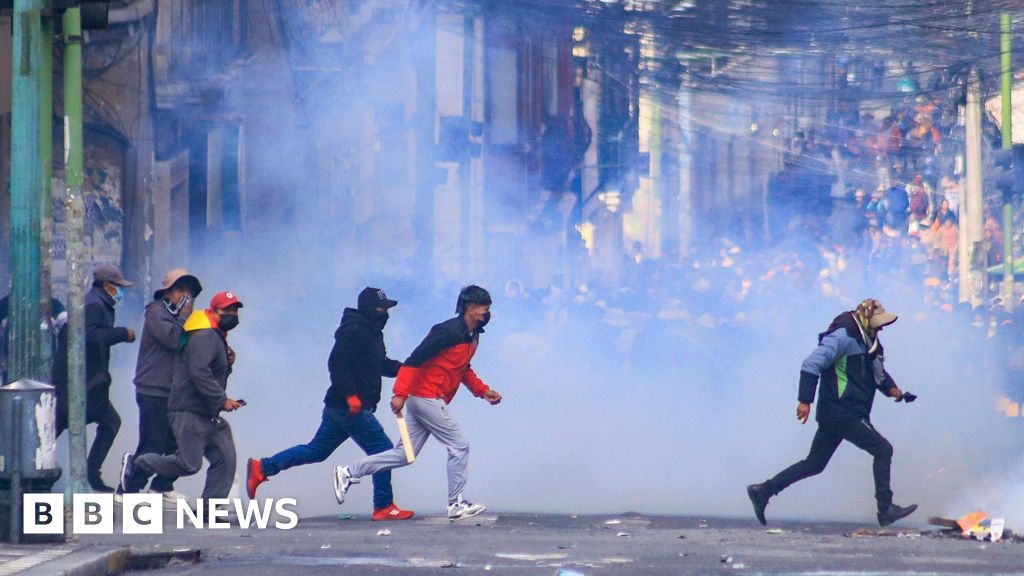
Bolivia’s capital, La Paz, became a battleground Monday as thousands of protesters filled the streets, their chants echoing against government buildings. Demonstrators—farmers, miners, teachers, and indigenous groups—carried banners demanding higher wages and an end to the privatisation of state-owned enterprises. The unrest, now in its third week, has paralysed parts of the country, with roadblocks, burning tyres, and clashes between protesters and security forces.
Police responded swiftly, firing tear gas canisters and deploying riot units to disperse crowds near the presidential palace. Video footage captured protesters throwing stones and setting small fires, while officers used shields to push back the front lines. The Interior Ministry confirmed at least 47 arrests and 23 injuries, though local medics reported higher numbers from unofficial sources.
| Group | Demands | Tactics |
|---|---|---|
| Farmers | Subsidies, price controls on fertilisers | Roadblocks, strikes |
| Miners | Higher wages, safer working conditions | Marches, clashes |
| Teachers | Wage increases, education funding | Strikes, rallies |
| Indigenous groups | Land rights, opposition to privatisation | Protests, cultural displays |
Attorney General Roger Mariaca announced that an arrest warrant would be issued for Mario Argollo, the head of Bolivia’s largest labour federation, the COB. Mariaca accused Argollo of terrorism and inciting violent protests, charges that have drawn sharp criticism from human rights groups. “This is an attack on legitimate dissent,” said Silvia Rojas, a La Paz-based labour lawyer. “Calling union activity terrorism sets a dangerous precedent.”
💡 Pro Tip
For journalists covering civil unrest, always verify arrest warrants directly with the judiciary rather than relying solely on official statements—prosecutors and police have been known to misrepresent charges in politically sensitive cases.
President Rodrigo Paz addressed the nation Monday night, acknowledging the economic hardship but condemning what he called “violent attempts to destabilise democracy.” He vowed to increase subsidies for fuel and food, but ruled out stepping down. “The government will not bow to mob rule,” Paz stated. His speech did little to quell tensions, with protesters vowing to escalate demonstrations if concessions aren’t met.
📋 By The Numbers
- 47 — Arrests reported by police in La Paz
- 23 — Injuries treated at local hospitals
- 3 — Weeks of continuous protests
- 1 — Arrest warrant issued against a union leader
The unrest has exposed deep fractures in Bolivia’s political landscape, with critics accusing Paz of mismanaging the economy and failing to address inequality. Inflation has soared to 5.4% this year, while the national currency, the boliviano, has lost nearly 10% of its value against the US dollar. The government’s recent decision to privatise lithium mining operations has further inflamed tensions, with protesters arguing that foreign corporations will exploit Bolivia’s resources without benefiting local communities.
- Escalation — Protests began in rural areas before spreading to urban centres like La Paz and Cochabamba.
- Demands — Wages, subsidies, and reversal of privatisation policies top the list of grievances.
- Government response — Police crackdowns and arrests, but no policy concessions yet.
The Bolivian Episcopal Conference, a coalition of Catholic bishops, has called for dialogue, warning that the country risks descending into prolonged unrest. “Violence begets violence,” said Bishop Eugenio Scarpellini. “The government must listen to the people’s legitimate concerns.” Meanwhile, regional observers are closely watching the crisis, with neighbouring countries expressing concern over potential spillover effects.
Key Points
- ⚠️ Thousands of protesters in La Paz demand President Paz’s resignation amid economic crisis
- 🔥 Police deploy tear gas as clashes erupt; 47 arrested, 23 injured
- ⚖️ Attorney General accuses union leader Mario Argollo of terrorism for alleged protest incitement
The crisis shows no signs of abating, with transport workers in Santa Cruz announcing an indefinite strike starting Thursday. Analysts warn that if the government fails to address the root causes of the unrest—rising living costs and dwindling job opportunities—the protests could escalate beyond Bolivia’s borders, drawing regional attention to one of Latin America’s most fragile democracies.
